
I have always been the kind of person who likes to write things down. It’s why I have this blog, and it’s how I process a lot of the world around me. But for years, there was one form of writing I consistently avoided and always struggled with: journaling. It felt too raw, too personal, and maybe too simple to actually solve any of my deeper issues. That’s why i decided to bring my journaling journey to a different level.
This past August, I decided to take the leap and try something different. I committed to an entirely offline, physical journal in a notebook. This wasn’t just about writing thoughts, though. It was a conscious attempt to rewire my brain. I also defined and tracked a number of habits for the entire month. The result? It completely changed my journaling journey and my perception of myself. But to understand the change, we need to start with the problem.
The Vicious Circle of Negative Thinking
If you’ve ever dealt with chronic negative self-talk, you know how quickly it can spiral. I am a person who tends to think in a negative way. It’s not just fleeting sadness; it’s a tendency toward depression, where my mind finds a dark lens for every situation. While thinking negatively, the thought of my own work, my ideas, and my value as a person gets worse and worse. It becomes a vicious circle that continues until it reaches a low point where I truly despise my life and myself. This isn’t just a bad mood; it’s a genuinely depressive state, and I was desperate to find a sustainable way out.
To break this pattern, I decided to try two things on a daily basis: start journaling and track my habits. The purpose of both was purely therapeutic and reflective, aimed at forcing my attention onto positive actions and achievements, no matter how small.
But where do you even begin? I spent time researching different methods online, checking out countless videos and articles until I had enough information to create my own hybrid system. To ensure everything was completely offline and that I couldn’t be hit by any distractions, I bought two Moleskin notebooks in the A5 format: one designated solely for journaling, and the other for habit tracking. This physical barrier to the digital world was key to making my journaling journey work.
My Journaling Journey: The Struggle to Stay Positive
I kept the actual journaling process surprisingly simple. Every day, I aimed for an entry of around half a page, maybe a full page, depending on what had happened. The absolute most important part for me was to stay positive.
When I started on August 1st, my entries were terrible. They were almost an unintentional log of everything that went wrong. I quickly realized it is not easy to shift your deep-seated negative mindset to neutral, let alone positive. It felt forced and fake at first.
It took time and a lot of forced effort until I figured out how to genuinely focus more on the positive parts of my day. I had to consciously change the language and structure of my thoughts. For instance, I had to stop thinking: “I wasted 8 hours of my life at work,” and start writing something like: “I was able to brainstorm on new projects and I actually got new ideas while getting paid.”
It is not as easy as it sounds. If you are a person who tends toward negative thoughts too, you know exactly what I mean. It is a slow, gradual process. Even now, I still catch myself initially thinking about my day in a negative way. But instead of letting that thought lead the narrative, I had to, and still need to, learn to reframe my day in a light that represents the good parts, the quality, and the positive outcomes.
Positive journaling
To help my mind shift from negative to positive, I started a simple but powerful exercise: I wrote down three things that I am proud of from my day, in addition to the main journal text. Initially, I just wrote about my day in a neutral, factual way, with no feelings, no emotions. But over time, and with more practice, I became capable of representing my true feelings and emotions in my words. This was a huge win. I found I could let go of all the negativity in my journal and still focus on the good things that happened.
We all know some days just suck, and we struggle, but letting those thoughts and emotions out on paper helps. But it’s equally important to appreciate the positive moments of each day. And these can be very small, almost mundane things. Did you make your coffee at home instead of buying an expensive one? Write it down. Did you manage to eat breakfast? Write it down. Did you resist that impulsive buy? Write it down. I had to learn that it’s these little things that add up, and when you reflect on them in the evening while journaling, it makes you feel better. At least, that is exactly how it worked for me.
Habit Tracking: Seeking Consistency and Structure
I always love to improve myself, but sometimes it is difficult to be consistent and to do regularly what I planned to do. To have a better overview of what I was actually doing and what I wasn’t able to achieve, I decided to track my habits. I researched several videos and articles and ended up using a simple, monthly habit tracking system.
I always dedicate a double page in my habit tracker notebook for each month. The entire setup is divided into three parts:
- Daily Summary (Left Page): I write down a short summary of the day, using just bullet points or short sentences. For example: “annoying people at work,” “playing games with my wife,” or “cooked delicious dinner.”
- Habit Tracking Matrix (Right Page, Left Side): This is the core habit tracking area. At the top, I define all the habits I want to track. I use a simple color-coding system:
- Black: Non-negotiable habits, the ones I absolutely must put focus on.
- Blue: Habits that I would love to achieve and improve.
- Red: Bad habits that I actively want to quit or get away from. Overall, I tracked around nine to ten habits. Whenever I successfully achieved a habit, I simply made a cross on the specific day.
- Sleep Tracker (Right Page, Right Side): I realized I wasn’t sleeping enough, but I needed an exact overview of when my sleep was insufficient. I created an X and Y axis, putting the hours on the X-axis and each day on the Y-axis. This results in an actual graph of my sleep schedule for the whole month. This visual data has been incredibly insightful.
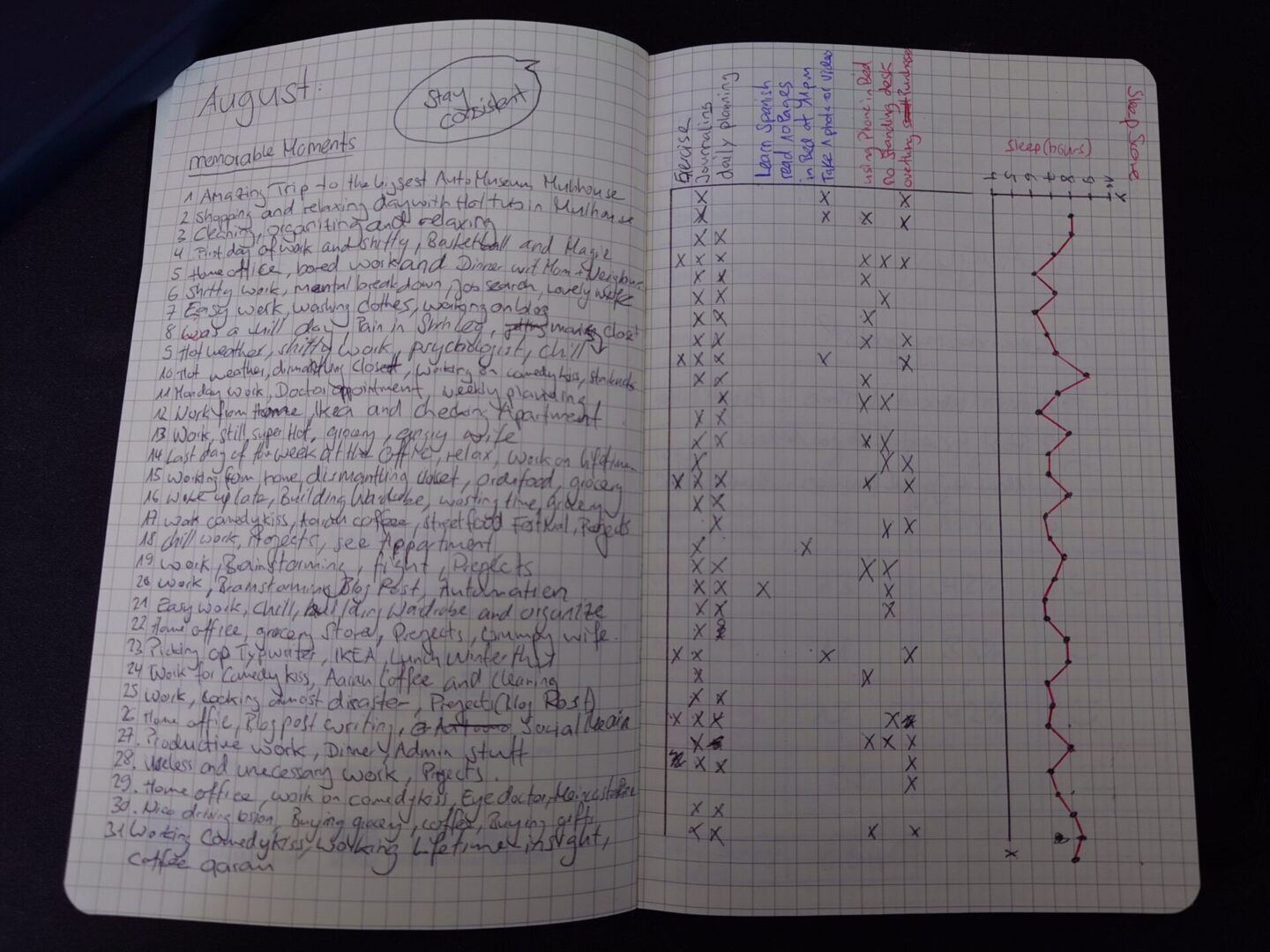
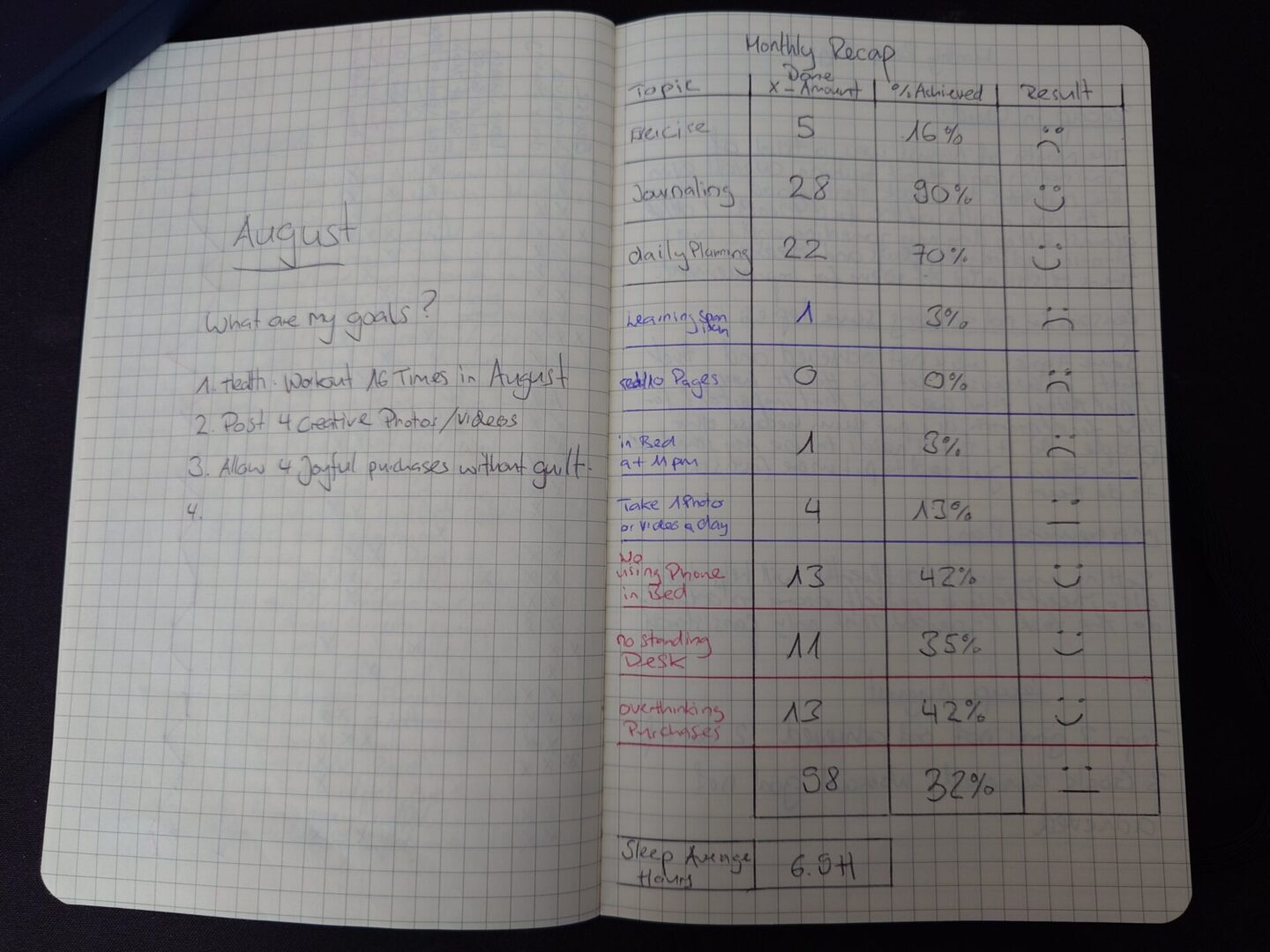
As soon as the month is finished, I evaluate all my habits. For this, I created a short overview on the next page, where I calculate the achievement ratio in a percentage for each habit and an overall achievement rate for the month. Additionally, at the beginning of the month, I defined three main goals that I wanted to achieve.
Journaling Lessons Learned: The Freedom to Adjust
So, how did this whole experiment go over a full month? I would say pretty good. Of course, it is not the perfect formula for guaranteed success, but it can definitely help you improve. However, I have to be honest: it can also limit you if you put too much focus on the habit tracker.
Life is unpredictable, and on some days, we end up doing different things than we planned. That doesn’t mean we are doing badly or that we screwed up. No, it’s the opposite: we learn on the way, and goals, even daily goals, can change. That is why it is so important to be ready to adjust. Forcing something that isn’t working is counterproductive. Just because you put a goal or a habit on the tracker at the beginning of the month doesn’t mean you have to stick to it if life proves it’s a bad idea.
Sometimes life has a different plan, and that is a good thing that we have to be able to enjoy as well. Much like when we travel and encounter unexpected challenges, like the weather at Irazú Volcano, we have to learn to embrace the change. (You can read about that trip here: My First Volcano Hike: An Unforgettable Day at Irazú Volcano, Costa Rica).
My thoughts
What I want to say is this: For me, the journaling definitely helped, and I will try to continue that as best as possible. The habit tracking also helped me a lot in seeing the improvements and achievements, but I got a little too focused on the goals and metrics. It can have a negative impact if you see that the progress of some habits is low. The tracker is a plan, and a plan can change. Even if you have a low percentage ratio on one of the habits, that doesn’t mean you didn’t perform well; it just means there were other areas you focused more on.
In the end, my journaling journey and the habit tracker should make you motivated to do things and make you more responsible in a good way. It should not make you stressed or anxious in any way, because that’s not its purpose. If you are struggling with a negative mindset or feeling overwhelmed by self-doubt, finding a system that allows you to vent the negative while consciously celebrating the positive is key. It ties back to the mental adjustments we often discuss on the blog, especially when dealing with major life shifts, like Nicole’s move to Switzerland (Read about her experience here: [Living as an Expat in Switzerland: An Interview with My Costa Rican Wife]).
I will continue my journal and habit tracking journey and might adjust it from time to time, or even a lot. Are you already using journaling in your daily life, or can you see yourself doing that? Let me know in the comments.